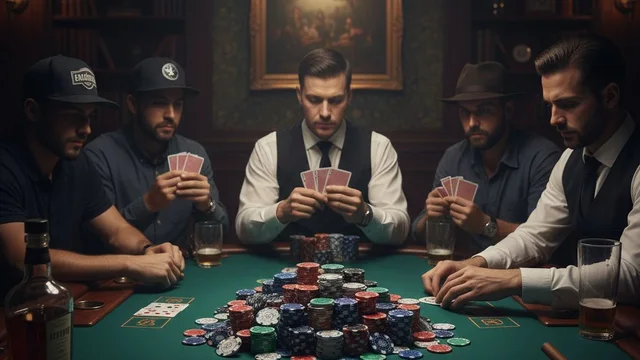











Establish the baseline first
Watch how someone normally sits, handles chips and looks around the table. A posture that is unusual for one player may be routine for another. Without a baseline, you risk treating ordinary behaviour as a special signal.
Use quieter moments as well as important hands. Compare the same player across several situations rather than comparing them with an imagined universal model of a confident or nervous player.
Timing helps give a change meaning
Notice whether a change follows looking at the cards, seeing the flop, facing a bet or putting chips in. The order matters: a reaction before a decision may have a different explanation from a reaction after a large bet.
For example, a player might lean forward because they are interested in the hand, because they cannot see the board clearly or because that is how they always sit. Match the observation with what actually happened.
A trembling hand has more than one explanation
Trembling can accompany stress or excitement. A player with a strong hand may shake; a player bluffing may shake too. The physical observation by itself does not identify which case you are seeing.
Look at other changes and the betting action, while keeping alternative explanations open. Do not turn a tentative body-language read into a reason to ignore a range that strongly favours a value hand.
Use tells as supporting information
Start with poker fundamentals: position, board, stack sizes and the action. Behaviour can add context to that analysis. It should not replace it or make you certain about cards you have not seen.
The PokerWise psychology and body-language book uses videos and explanations to practise this observation process. Begin with its two public samples, then ask what you observed, what you inferred and what evidence would change your mind.