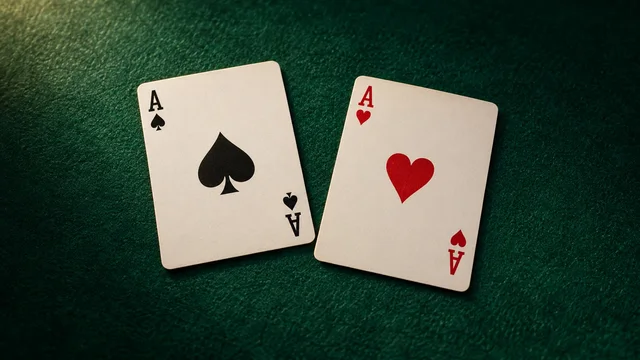











Two private cards, five community cards
Each player receives two hole cards. The flop adds three community cards, the turn adds one and the river adds one. Players still in the hand share these board cards. There is a betting round before the flop and after each stage of the board.
At showdown, make the strongest five-card hand available from your seven cards. You do not have to use both hole cards. If the board itself is your best hand, you are playing the board.
Know what each action does
Checking passes the action without betting, but it is only possible when you face no bet. Calling matches the amount required to stay in the hand. Raising increases that amount, while folding gives up your claim to the pot.
For example, facing a €10 bet is different from being first to act in an unbet pot: you cannot check instead of calling that €10. Learn the legal actions before worrying about which one is strategically best.
Hand rankings and kickers
Compare hand categories first: a flush beats a straight, and a straight beats three of a kind. Within a category, card ranks matter. With a pair, compare the pair first and then the remaining cards in descending order.
On an A-9-7-4-2 board with no flush, A-K beats A-Q because both players have a pair of aces and the king kicker is higher. Suits do not act as a tie-breaker. When both best five-card hands are identical, the pot is split.
Why position is worth learning early
The dealer button helps determine the order of action. Acting later usually lets you see what others do before deciding yourself. That extra information changes the value of many starting hands.
Practise describing a hand in order: position, cards, previous action and the decision you face. This simple routine prepares you for the rules and basic strategy books without asking you to memorise a play for every possible hand.