










Texas Hold’em: understand your first hand
Learn the flow of Texas Hold’em, betting actions, five-card hand selection and the role of position, with a simple example.
Read the guidePart of the PokerWise poker learning app. · 01 / 08
Learn how a Texas Hold’em hand works, how hands are ranked and what the words around the table mean. A starting point before studying strategy.
Coming November 2026
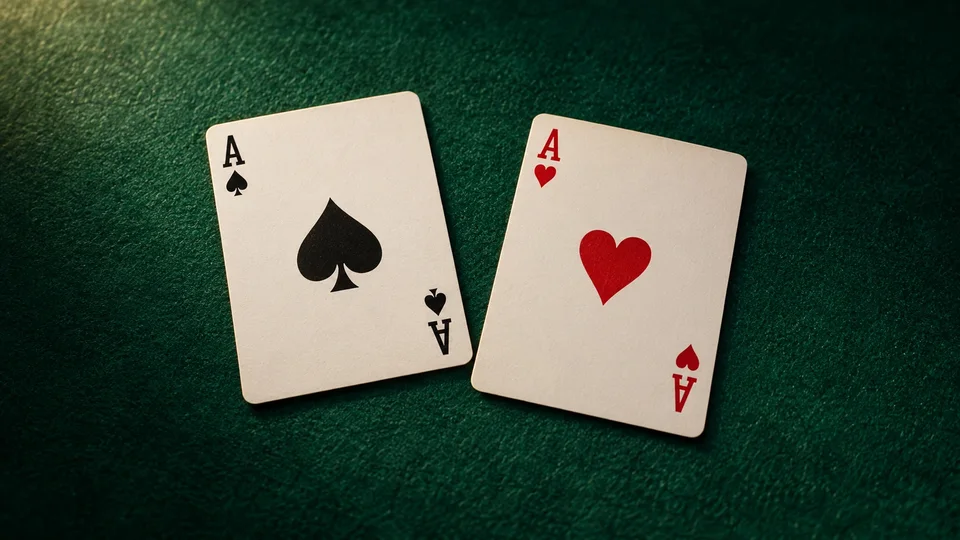
Learning poker starts with understanding what happens at the table. This book explains Texas Hold'em as a sequence of decisions: where the button and blinds are, when the community cards appear and which actions are available. You learn to follow a hand from the first forced bets to the showdown, rather than trying to guess the right move while the rules are still unclear. That foundation also makes hand histories and discussions of strategy easier to understand.
The second part gives you a working poker vocabulary. Position, calling, raising and the structure of a betting round are practical tools for describing a situation, not just terms to memorise. The aim is to say what has happened accurately before judging what should happen next. Beginners can start here; players returning after a break can use the book to refresh the details that often get overlooked during a fast game.
Follow the dealer button, small blind and big blind through a Texas Hold'em hand. Connect preflop, flop, turn and river to their betting rounds, and learn how the best five-card hand determines the winner at showdown. The order matters because an action that is legal in one spot may not be available in another.
Build the vocabulary used in later strategy lessons. Learn to distinguish checking from calling and a bet from a raise, and identify positions around the table. Use these terms to explain the action precisely instead of saying only that someone played aggressively or had a good hand.
This is a useful starting book if you can name strong hands but still hesitate when several players share the same board. Being able to identify the winning five cards comes before deciding whether a bet was sensible. In Texas Hold’em, the two cards you hold do not automatically both belong to your final hand.
For example, take a K-K-7-7-2 board and two players holding A-Q and A-J. Both have kings and sevens with an ace kicker, so the pot is split. The queen and jack are outside the best five-card hand. Practising this comparison helps you separate hand strength from the appearance of your hole cards.
Pause after a lesson and describe an imaginary hand aloud. State the position, the cards already dealt, the previous action and the choices that remain. If you cannot distinguish a check from a call in that example, return to the rule before moving on. This simple exercise exposes missing knowledge without asking you to risk money at a table.
Use the book's questions to check your reasoning, not just to recognise a familiar answer. Explain why the alternatives do not fit the situation, then revisit a lesson when the explanation is unclear. Once you can follow the action comfortably, continue with basic strategy. Knowing the rules will not tell you the best play in every spot, but it gives every later calculation and observation a reliable framework.
Build on this topic with the rest of the PokerWise poker curriculum. Choose the next book that fits the decisions you want to improve.
Connect starting hands, position and pot odds to the decisions you face before and after the flop. Learn to build a plan rather than react to each card in isolation.
Study how decisions change as the blinds rise and stacks get shorter. Explore M and Q ratios, all-in decisions, short-handed play and heads-up situations.
Watch and analyse behaviour at a live table. Establish a baseline, recognise changes in posture and hands, and weigh stress or confidence signals against the poker action.
Explore the conditions that make a bluff plausible: opponent tendencies, position, betting patterns, board texture and a story that stays consistent across streets.
Work through 45 decision spots, from basic preflop choices to aggression, multi-street plans and tournament pressure. Examine what changes a decision and why.
Put variance, bankroll management and decision routines into perspective. Study EV, ROI and tournament pressure without confusing a short-term outcome with a good decision.
Recognise habits that undermine sound decisions: bluffing in the wrong spots, poor bankroll discipline, unhelpful coinflips and reacting without understanding your position.